


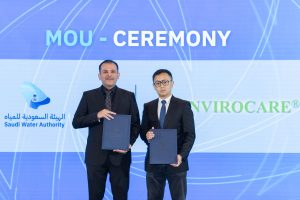
Envirocare is proud to announce the signing of a Memorandum of Understanding (MoU) with the Saudi Water Authority during the prestigious Saudi-Singapore Water Forum. This milestone collaboration represents a significant step toward fostering strategic partnerships in wastewater treatment and sustainable water management, leveraging shared expertise to address pressing global water challenges. By combining Envirocare’s innovative wastewater solutions with the Saudi Water Authority’s advanced infrastructure, this MoU paves the way for enhanced cooperation in research, technology exchange, and capability building.
The MoU establishes a comprehensive framework for collaboration, emphasising the integration of cutting-edge research and innovation to align with global sustainability goals. Saudi Arabia’s leadership in water management, exemplified by the world’s largest water pipeline network—spanning 14,217 kilometres and operated by the Saline Water Conversion Corporation (SWCC)—serves as a foundation for this partnership. The Kingdom’s state-of-the-art wastewater treatment plants and circular economy initiatives highlight its commitment to optimising resource management, making it an ideal partner for Envirocare’s mission to deliver efficient wastewater treatment systems.
Objectives of the MoU: Driving Sustainable Water Innovation
This partnership outlines clear objectives across three key areas, all of which incorporate advanced wastewater treatment and management strategies to promote sustainability:
-
Academic Collaboration:
-
Facilitating academic exchanges between institutions to foster knowledge sharing in water and wastewater treatment.
-
Enhancing the credibility of both organisations through joint educational programs.
-
Enriching cultural and scientific understanding, with a focus on sustainable water technologies.
-
-
Research and Development:
-
Driving the development of innovative technologies for sustainable wastewater solutions, including advanced treatment processes and water recycling systems.
-
Expanding practical research initiatives to tackle real-world water challenges, such as wastewater reuse and pollution control.
-
Contributing to global efforts in water sustainability and the circular economy by integrating wastewater management best practices.
-
-
Capability Enhancement:
-
Building the competencies of water sector professionals through training in wastewater treatment technologies and operations.
-
Sharing global knowledge and skills to improve efficiency in water resource utilisation.
-
Maximising resource optimisation, including the implementation of energy-efficient wastewater treatment plants to reduce environmental impact.
-
Through these objectives, Envirocare and the Saudi Water Authority aim to create synergies that enhance wastewater treatment capabilities, promote water conservation, and support the transition to a circular economy in water management.
Saudi Arabia’s Leadership in Water and Wastewater Management
Saudi Arabia stands as a global benchmark in water infrastructure, with achievements that underscore its dedication to sustainability. The extensive 14,217-kilometre pipeline network ensures reliable water distribution, while modern wastewater treatment facilities treat and reuse water to minimise waste. The Kingdom’s circular economy approach in water management—focusing on recycling, reuse, and innovation—aligns perfectly with Envirocare’s expertise in wastewater treatment solutions. By partnering with the Saudi Water Authority, Envirocare gains access to these cutting-edge systems, enabling collaborative advancements in treating industrial and municipal wastewater, reducing pollution, and enhancing water security.
Envirocare’s involvement will bring specialised knowledge in designing and implementing wastewater treatment systems that are scalable, efficient, and compliant with international standards. This includes technologies such as membrane bioreactors, advanced oxidation processes, and automated monitoring systems, which can be adapted to Saudi Arabia’s unique environmental and operational needs.
Envirocare’s Role in Global Wastewater Treatment
As a leader in wastewater treatment and environmental solutions, Envirocare has a proven track record of delivering innovative systems for industrial and municipal clients worldwide. Our expertise extends to comprehensive wastewater management strategies that address contamination, promote reuse, and ensure regulatory compliance. This MoU with the Saudi Water Authority expands our global footprint, allowing us to contribute to large-scale water projects while learning from Saudi Arabia’s pioneering efforts.
Key aspects of Envirocare’s wastewater treatment solutions include:
-
Advanced Filtration and Biological Treatment: Removing contaminants effectively to produce high-quality effluent.
-
Water Recycling and Reuse: Reducing freshwater demand through closed-loop systems.
-
Energy Efficiency: Incorporating low-energy technologies to lower operational costs and carbon emissions.
-
Innovation in Circular Economy: Turning wastewater into a resource, supporting zero-waste goals.
This partnership not only strengthens Envirocare’s capabilities but also positions us to collaborate on future projects involving wastewater treatment plant upgrades and new developments in the region.
Why Wastewater Treatment is Crucial in Water Collaboration
In an era of increasing water scarcity, wastewater treatment plays a pivotal role in sustainable water management. Untreated wastewater can lead to environmental degradation, health risks, and resource depletion. Through this MoU, Envirocare and the Saudi Water Authority are committed to advancing wastewater solutions that:
-
Ensure a clean water supply by treating and reusing wastewater.
-
Protect ecosystems by preventing pollution in water bodies.
-
Support economic growth through efficient resource management.
-
Align with global standards, such as the UN Sustainable Development Goals for clean water and sanitation.
By focusing on wastewater treatment, this collaboration will contribute to resilient water systems capable of addressing climate change, urbanization, and industrial demands.


 Mitra Sunter Boulevard, Block B